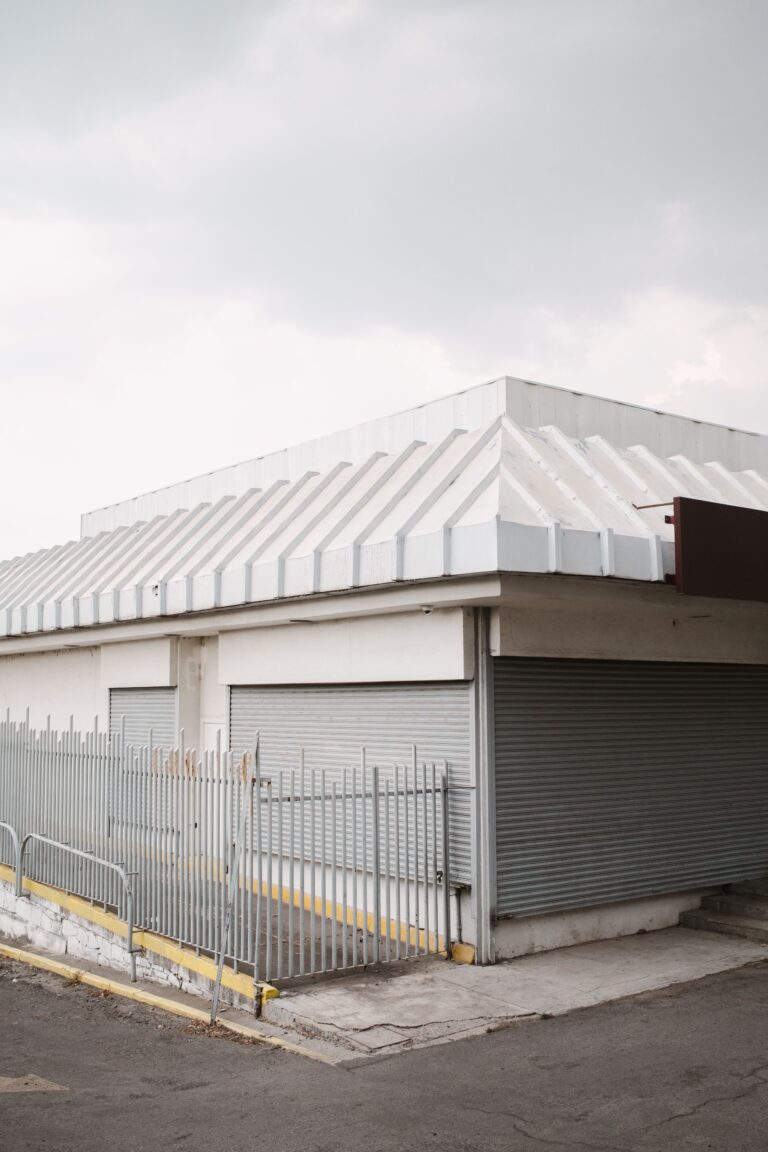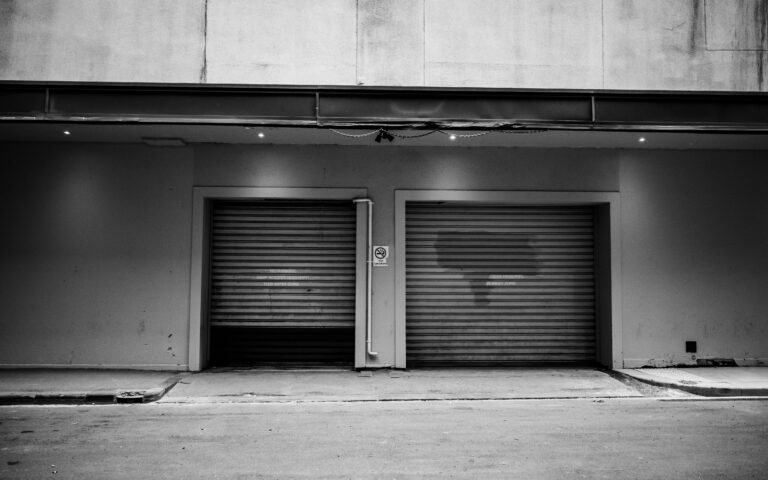
Most of the calls I get are for roll-down shutters. They’re the visible install — the metal that comes down at close and goes back up in the morning — and they’re what most storefront owners picture when they think about security. Accordion gates come up less often, but when the conversation starts there’s usually a real reason. The opening’s too wide, the budget’s tight, or the building’s an industrial space where a shutter isn’t actually the right answer.
Here’s how I walk the difference between the two when an owner is trying to figure out which one fits.
What’s an accordion gate, actually?
An accordion gate is a folding metal gate that pulls horizontally across an opening. Picture a row of vertical metal pickets connected with crossing diagonals, like the gates on old elevator doors, but built for storefront use. When the gate’s open during the day it folds back against one side of the opening. When it’s closed at night it pulls across the opening and locks at the other end.
The gate sits as an open lattice across the opening. You can see through it, air moves through it, and a person on the sidewalk can still tell what’s behind it. It covers the opening but doesn’t seal it.
That’s the most important thing to understand about accordion. It works as a barrier without working as an enclosure.
Where does an accordion gate win?
Four cases.
Very wide openings. Accordion gates can span openings that roll-down shutters can’t. The max width on a single accordion run is around a hundred feet. A roll-down shutter’s working width is much shorter, and the wider the opening the bigger the housing and motor have to be. For warehouse openings, loading dock arrays, and parking-structure exits, accordion is often the only product that physically fits the opening.
Budget-constrained installs. Accordion gates are cheaper than roll-down shutters. The materials are simpler, the install is faster, and there’s no motor unit. For an owner who needs storefront security and has a fixed budget that won’t reach a full roll-down install, accordion is the honest middle path. The product does real work as a barrier even though it isn’t a shutter.
Interior security partitions. Inside a mall, a covered arcade, or a multi-tenant building, accordion gates work well as the closing barrier on a tenant space whose perimeter is already protected by the larger building. The tenant gets the visual signal of being closed, the storefront stays accessible during the day, and the install doesn’t compete with the larger building’s aesthetics.
Industrial and warehouse openings. This is the dominant accordion install in my book. Loading bays, equipment cages inside a warehouse, side doors that need to be locked at night. The accordion gate is the standard product for those situations because it’s wide-capable, cheaper than a shutter, and doesn’t need a motorized install.
Where does a roll-down shutter win?
Pretty much everywhere else, and worth being specific about why.
Solid storefront enclosure. A roll-down shutter closes the opening completely. The slats are continuous, the surface is solid, and the storefront is sealed off when the shutter’s down. An accordion gate covers the opening but anyone passing by can still see what’s inside. For a liquor store, a dispensary, or any retail space whose inventory is visible from the sidewalk, the solid enclosure of a roll-down is a meaningful difference. It changes both what an attacker can see and what they have to think about.
Visible deterrent on the storefront. A roll-down shutter announces from a block away that the storefront is hardened. The accordion gate’s open-lattice profile reads as a softer barrier, even when the underlying metal is the same gauge. For high-crime corridors and high-foot-traffic blocks, the deterrent effect of the visible shutter matters.
Motorization. Roll-down shutters can be motorized — wall switch, key fob, phone app, the whole control package. Accordion gates can’t. They’re a manual product. For a storefront where motorization is the right operational choice, accordion isn’t on the table.
Service life. A properly installed roll-down shutter with a good motor lasts decades on the slats and structure. Accordion gates last too, but the pivot points and the locking mechanism wear faster under daily use. For a storefront that opens and closes every day for years, the longer service life of the shutter usually justifies the higher initial spend.
How do I actually walk the choice with an owner?
Three questions, asked in order.
One — how wide is the opening? If it’s over twenty feet wide, accordion gets serious consideration because the shutter housing and motor required for that width get expensive fast. If it’s over forty feet, accordion is often the only practical product.
Two — does the storefront have visible inventory at night? If yes, the solid enclosure of a roll-down matters and we’re probably installing a shutter. If no — if the opening is a warehouse bay, an industrial loading dock, an interior partition — accordion is on the table.
Three — does the install need motorization? If the answer is yes, we’re installing a shutter, because accordion gates don’t motorize. If the answer is no, accordion stays in the conversation.
Most retail storefronts answer those three questions in a way that lands on a roll-down shutter. Most warehouse, industrial, and interior partition installs answer them in a way that lands on accordion. The split is consistent across what I’ve installed.
Where do owners get this wrong?
Two common mistakes.
They pick accordion for a retail storefront to save money and then regret the visual. The accordion gate is cheaper but it doesn’t carry the deterrent signal that a solid shutter does. For a liquor store on a busy corridor, that visual matters. Owners who installed accordion to save and then watched the storefront still get tested sometimes come back wanting a shutter retrofit. The retrofit costs more than the original difference would have been.
They pick a roll-down shutter for a warehouse bay where accordion would have been the right product. Wider industrial openings drive shutter costs up fast because the motor and housing scale with the width. Owners sometimes pay for a shutter at width where accordion would have worked just as well for the threat profile and saved real money. The shutter isn’t wrong for the install — it’s just heavier spending than the threat required.
What should you do right now?
One — measure the opening before you call. Width and height. The numbers drive the conversation more than the product preference does.
Two — describe what’s behind the opening. Visible retail inventory? Warehouse stock? Empty office? The answer changes which product I’d recommend.
Three — name your priority — budget, longevity, deterrent, or motorization. Different priorities land on different products. Tell me yours up front and the conversation gets shorter.
Questions storefront owners ask after reading this
Can you install both products at the same storefront? Sometimes, on multi-opening buildings. A roll-down shutter on the main customer storefront and an accordion gate on the warehouse loading bay in back is a common combination. Each product fits the opening it covers.
How long does an accordion gate actually last? Decades on the metal itself. The pivot points and the locking mechanism need attention every five to seven years depending on how often the gate gets opened and closed. The maintenance pattern is similar to a roll-down shutter but the parts are cheaper.
Is an accordion gate enough for a back door? Usually no. The back door of a retail building is a planned-attack entry point — somebody specifically aiming at the back where they have time and cover. The open-lattice profile of an accordion lets a person see the door and the lock from outside. For a back door I’d recommend a reinforced commercial door, a real deadbolt, and an alarm contact. If a barrier is needed on top of that, a roll-down or a back-door grille fits better than an accordion gate.
What about scissor gates? Are those the same thing? Different product, similar category. Scissor gates were the old standard for liquor stores through the 1990s and a lot of them are still up. The conversation about replacing a scissor gate is usually about whether to replace it with another gate or to upgrade to a roll-down shutter. I cover that in detail in the replacement post.
Where to start
If you’re trying to figure out which product fits your storefront, give me a call. I’ll come walk the opening with you and tell you what I’d install. If accordion’s the honest fit, I’ll spec it. If the building wants a roll-down, I’ll tell you that too.
— Jessie Bajwa
Owner, Affordable Security Shutters
Fairfield, CA · 707-840-3435