If you’re shopping for a security shutter, this is one of the first decisions you have to make. Solid or perforated. There are partial versions of each, but the core question is whether your shutter is opaque or whether it lets light and visibility through.
Most explanations of this online are written by manufacturers trying to sell you something. Here’s the plain version, drawn from what we’ve actually installed across nearly 500 shutters, and why the wrong choice is more common than you’d think.
What does a perforated security shutter actually look like?
The shorthand I use when somebody asks me what a perforated shutter looks like: it looks like a Connect Four board. A grid of square holes through the metal slats. The aluminum is still there, the structure is still there — it’s just punched through with a regular pattern that lets light, air, and sightlines pass.
If you can picture that, you can picture the whole product family. Solid is the same slats with no holes. Partially perforated is the same slats with about 15% open area. Perforated is about 50% open. Counter shutters are a smaller specialty version for windows and serving openings rather than full storefronts.
By the way: the perforations are square, not round. Round holes look like bullet holes. Nobody wants their storefront to look like a violent metaphor. Square is the right call.
What are the four main types of security shutters, and what’s each one for?
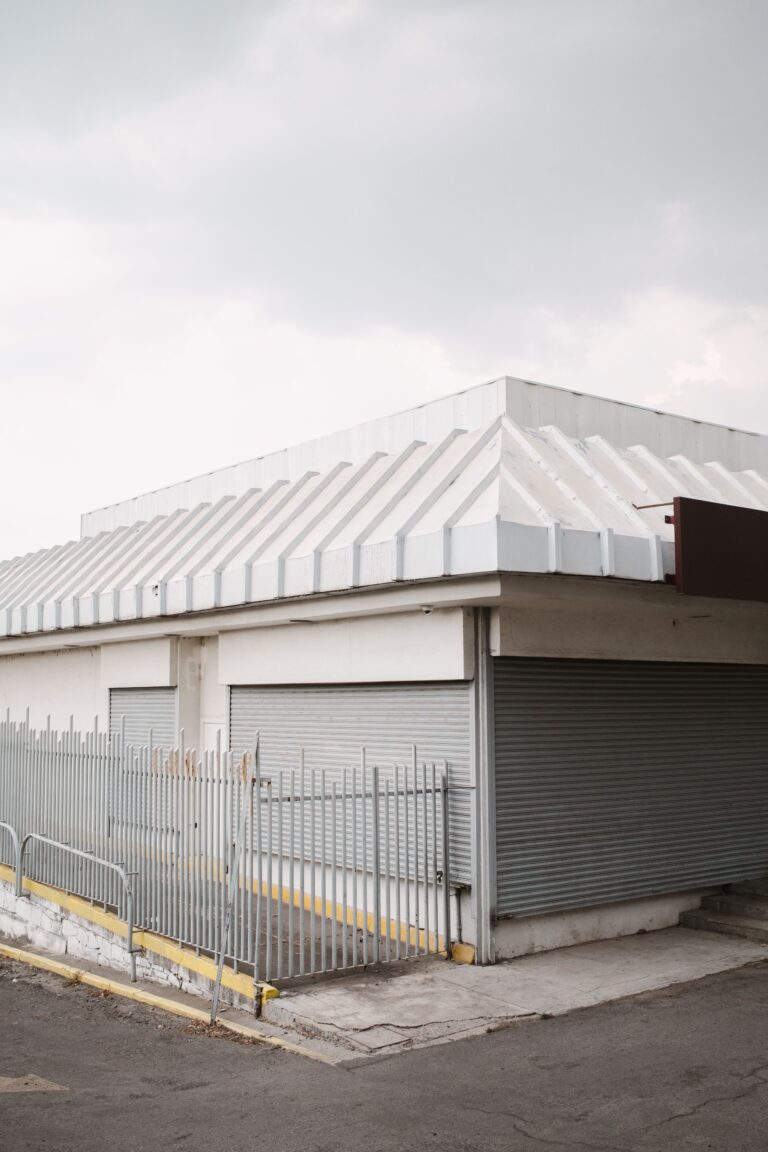
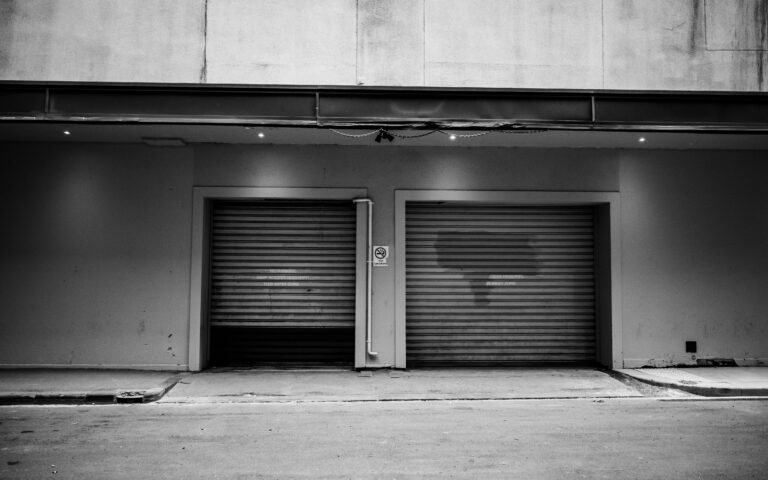
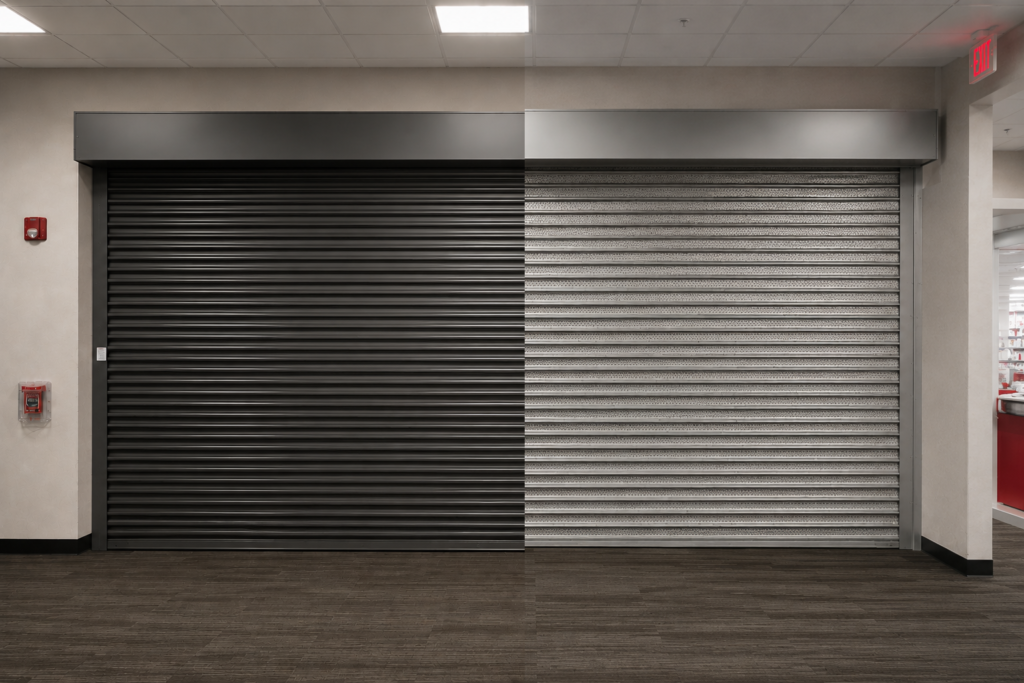
Solid roll-down (0% open). A wall when it’s closed. Fully opaque aluminum slats with no perforation. You can’t see in, you can’t see out, you can’t shine a light through it. The most common choice for liquor stores, gas stations, convenience stores, and any retailer whose primary concern is keeping people out and keeping product invisible after hours.
Partially perforated (15% open). Mostly opaque, but with a smaller percentage of perforation that lets some light and visibility through. Useful for storefronts that want a deterrent presence without going to a full perforated shutter. A middle option, fairly uncommon in our installs but a fit for a specific kind of operator.
Perforated (50% open). The Connect Four product. Significant open area throughout. Looks more like a fence than a wall. Light and air pass freely; the storefront is still visible from outside; signage and brand can read through it. The dominant choice for jewelry, designer fashion, dispensaries with display compliance requirements, and high-end retail.
Counter shutter. Smaller, often interior, designed to close off a counter, window, or service opening rather than a full storefront. Pharmacy windows, check-cashing booths, hospital intake counters, government service offices. Solid or perforated depending on use case. Different product, often confused with full storefront shutters in research.
How should you actually decide between solid and perforated?
Across our installs, roughly 70% of operators choose solid, 25% choose perforated, and 5% land on one of the partial variants. The decision usually comes down to four questions.
Do you want product visible from the street after hours? If yes — perforated. If no — solid. A liquor store wants product invisible. A jewelry store wants product visible (it’s part of the brand experience). A dispensary in a city with display-case compliance requirements may need product visible to satisfy the city, even if the operator would prefer otherwise.
What’s your primary threat? If your concern is opportunistic break-ins by people who’d be deterred by a visible barrier, perforated is fine. If your concern is determined burglary by people who’ll cut, drill, or pry through whatever’s there, solid offers more material for them to defeat. Both products are rated for forced-entry resistance, but solid is harder to compromise quickly.
How does the storefront read from the outside? A solid shutter on a high-end fashion boutique looks like the store closed permanently. A perforated bronze shutter on the same boutique looks like the store is closed for the night. The brand experience matters, and for retailers where the storefront is part of the marketing, perforated wins almost every time.
Is ventilation or air movement needed? Some commercial spaces — restaurants with venting, certain food prep areas, warehouses with airflow requirements — benefit from perforation that lets air pass when the shutter is closed. Less common but worth noting.
The decision should almost always be driven by use case, not by which one’s cheaper. The price difference varies more by size, motor, and finish than by whether the slats are punched or solid.
What’s the most common mistake operators make on this decision?
The most common bad outcome we see is a high-end retailer who installs a solid shutter because somebody told them it was “more secure,” then regrets it within the first week because the storefront looks closed permanently and the brand is hidden every night. They had a real problem to solve — the shutter is fine, the threat is mitigated — but they bought the wrong shape of product for their actual business.
The second most common mistake goes the other way. A liquor store owner gets talked into a perforated shutter because it “looks nicer,” then discovers that nighttime visibility into the store is exactly what was attracting attempts in the first place. The point of a liquor store shutter is to make the store look closed and uninteresting from the street. Perforation works against that goal.
Both mistakes share the same root: the operator made the decision based on product features instead of use case. Either you want product visible at night, or you don’t. Start there. Everything else follows.
What color and finish should you choose?
Both solid and perforated shutters come in roughly the same finish family: white, black, gray, silver, bronze, cream, and beige are the standard options. Bronze and black are the most common for high-end retail because they read as architectural rather than industrial. White is the most common for convenience and liquor — it disappears against most storefronts during the day. Gray and silver are the default for warehouse, industrial, and lower-priority aesthetic situations.
For the dispensary and jewelry installs we do, color choice often gets more time than the solid-vs-perforated decision. The material decision lasts the life of the building; the color choice is what people see every day.
What should you do right now if you’re trying to decide between solid and perforated?
One — answer the visibility question first. Do you want product visible from the street after hours, or do you want the store to look closed and uninteresting? This single decision drives about 70% of the choice. Most other questions are downstream of it.
Two — name your primary threat. Opportunistic versus determined. If you’re protecting against people who’d walk past a visible barrier, perforated is enough. If you’re protecting against people who’ll cut, drill, or pry, solid offers more material to defeat. Both are forced-entry rated, but the time-to-compromise is different.
Three — match the shutter to the brand, not the brand to the shutter. A wall reads as “closed permanently” on a high-end storefront. A perforated bronze shutter reads as “closed for the night.” If your brand depends on the storefront staying part of the brand experience, perforated wins. If your storefront’s job is to look unremarkable and tight, solid wins. Decide which one your business needs and the product follows.
Questions storefront owners ask after reading this
Will a perforated shutter still protect against a forced-entry attempt, or do I need solid for that? A rated perforated shutter still protects. The aluminum slats and the mounting are the same structural product as a solid shutter — the perforations are punched through the metal, not gaps between slats. Where solid wins is time-to-compromise on a determined attack with cutting tools, because there’s more material per square foot to defeat. For an opportunistic attempt (pry, kick, brick through glass), perforated and solid both stop it. For a planned attack with an angle grinder, solid buys you more minutes. Match the spec to the realistic threat for your store, not the worst-case threat for everyone’s store.
Can I mix solid and perforated on the same storefront — solid for the door, perforated for the windows? Yes, and it’s a more common spec than people expect. A common pattern: solid shutter over the main entry door (which an opportunistic attempt would target first), perforated over the display windows on either side (so the brand stays visible after hours). The two products integrate well because they use the same housing and tracks. The aesthetic transitions cleanly if both are finished in the same color. Ask the installer to walk you through what the mixed install would look like before you commit.
Does the color or finish I pick affect security at all, or is it purely aesthetic? Almost purely aesthetic for the structural protection. Where finish matters operationally is durability — powder-coated finishes hold up better than painted ones in coastal humidity and against sun fade. Anodized aluminum (the bronze finishes most high-end retail uses) holds color longest. Color also matters for how visible the shutter is from a distance at night, which has some deterrent effect — but the deterrent comes mostly from the shutter being there, not from what color it is.
How quickly does either type close and open during normal operations? Motorized shutters of either type close in about 20 to 40 seconds depending on the size of the opening. A typical commercial double door is a 25-to-30-second cycle. Manual crank versions are slower — closer to a minute or two for the same opening, plus the time it takes for staff to actually crank it. For high-traffic stores or stores with multiple shutters that need to close near simultaneously, motorized is the default. For lower-traffic or backup applications, manual is fine and removes the dependence on power.
Where to start
If you’re still not sure which is right for your store, send us a photo of your storefront and a sentence about your business. I’ll tell you which product I’d recommend and why — based on what I’d actually choose if it were my store, not what I’d most like to sell you. Both products are in my portfolio. I don’t have a preference between them. I have a preference for installing the right one.
— Jessie Bajwa
Owner, Affordable Security Shutters
Fairfield, CA · 707-840-3435