Most security companies talk about shutters the way you’d expect. They tell you they’re tough. They tell you they’re a deterrent. They show you a stock photo of a metal door and tell you to call.
I’m going to do something different here. I’m going to show you what the actual numbers say.
Over the last six years, we’ve documented 156 commercial security shutter installs across Northern California. Liquor stores, gas stations, dispensaries, jewelry stores, government buildings, restaurants, courthouses, dentists, optometrists, body piercing shops, social services offices, prisons. Cities from San Francisco to Sacramento to Vallejo to Redding to Santa Clarita. Almost 500 individual shutters in the field.
When you look at six years of installs as one dataset instead of one job at a time, you start to see things you wouldn’t otherwise notice. Patterns about who calls, when they call, what they’re worried about, and what actually changes their mind. Most of what I’m about to share is not in any marketing brochure — including ours, until now — because it’s only visible at scale.
How many storefront security calls are reactive versus proactive?
Of the 156 installs we have on record, about 53% were reactive — the customer called after a break-in, attempted entry, or vandalism had already happened. About 45% were proactive — they called before something happened, usually during a new build, remodel, or out of straightforward worry. The remaining 2% were code compliance — the city, state, or licensing body required the install.
The first thing this tells you: most operators wait. Despite knowing their store is at risk — a fact pretty much every commercial owner I’ve talked to acknowledges — only about 45% of them act before something happens.
The second thing it tells you: the 2% code-compliance number is small but growing. A few years ago it was effectively zero. As more cities and states write specific physical-security language into commercial licensing, this category is going to expand. We’ve already seen it materialize for cannabis, social services, and certain liquor configurations. It’s coming for more verticals.
Why do liquor stores wait to install shutters while dispensaries don’t?
This is the finding that surprised me when I sat down and looked at the data. The two biggest commercial verticals we serve — liquor and cannabis — call us for completely opposite reasons.
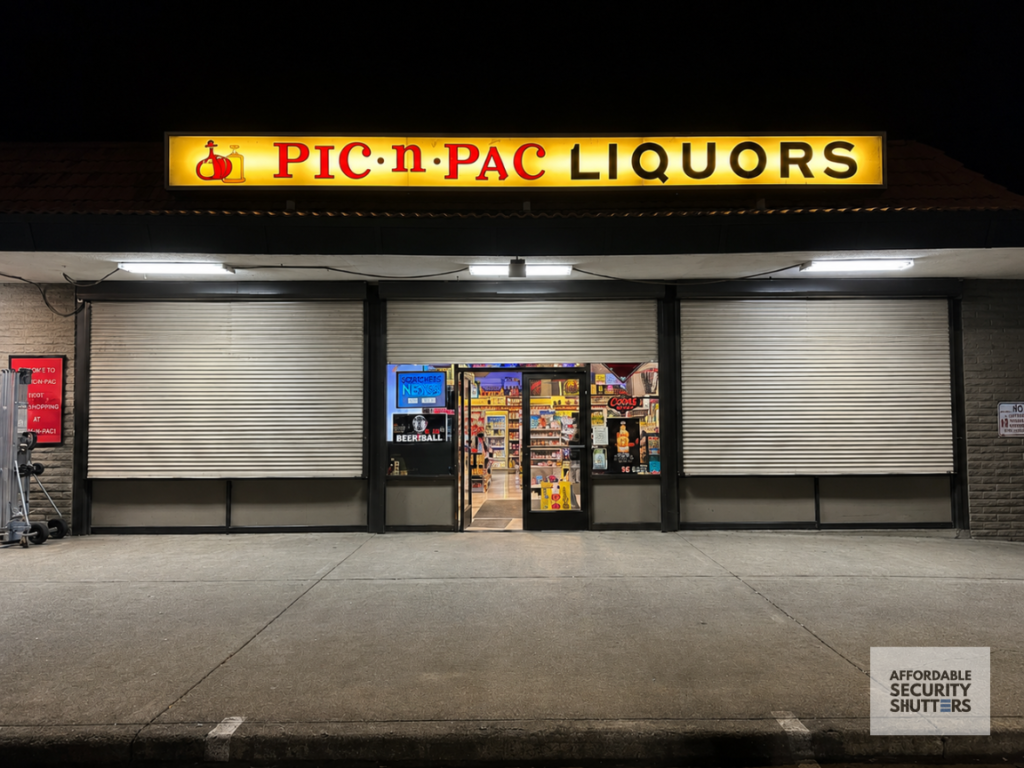
Liquor stores are 79 of our documented installs. About 63% of those were reactive. Liquor owners overwhelmingly act after the fact — somebody breaks in, then they call.
Cannabis dispensaries are 17 of our documented installs. About 65% of those were proactive. Dispensary owners overwhelmingly act before anything happens — usually during build-out, remodel, or to satisfy licensing.
The split is almost a perfect mirror image. Why is the gap this large? Three reasons, all of which I see on the ground.
Cannabis operators have insurance and licensing pressure that liquor operators don’t. A dispensary can’t open in California without satisfying physical-security language in their conditional use permit. That language often specifies things — barriers, enclosures, after-hours product storage — that effectively require shutters or equivalents. A liquor store has no comparable mandate.
The cost-benefit math is different. A dispensary’s inventory is worth orders of magnitude more per square foot than a liquor store’s. A typical successful dispensary holds product worth tens of thousands of dollars overnight. A typical liquor store doesn’t. When the asset is bigger, the prevention spend pencils faster.
Cannabis is a younger industry with younger operators. Most of the dispensary owners I work with came up post-2018. They’ve watched their peers get hit. They build security into the business plan. Most liquor store owners came up before the current crime cycle and built the store before security was a top-three concern. The shutter is a retrofit, not a foundation.
Which storefront vertical is growing fastest in the security shutter market?
In 2022, we did zero cannabis installs. Not one.
In 2023, we did three. In 2024, four. In 2025, ten — meaning cannabis represented one of every four installs we did that year.
A lot of that growth came from one operator — a multi-location California cannabis chain that found us through a camera-installation contractor and proceeded to bring us in for store after store. But the underlying shift is broader than that one account. As dispensaries hit their second wave of openings (refurbishments, relocations, additional licensed locations), they’re building in physical security at the wall stage instead of bolting it on later. That’s the right way to do it. It saves money, it satisfies the city faster, and it doesn’t disrupt operations.
Where does most of a security shutter installer’s work actually come from?
Here’s the breakdown of how the 156 jobs found us.
Referrals — 39% of jobs. Past clients telling other store owners. Manufacturers (QMI, Allutech) sending leads to local installers. General contractors who know us from a build-out. The single largest source of new business by a wide margin.
Previous clients — 22% of jobs. Operators who used us once and called us again — for a second store, for a renovation, after a separate incident at a different property. About one in five jobs is a callback from someone we’d already worked with.
Network — 16% of jobs. Community connections — temple, industry association, fellow franchisees, family. Distinct from referrals because there’s no transactional handoff; people who know me find me when they need me.
Cold inbound — 22% of jobs. Phone calls and inbound web inquiries from owners who don’t know us yet. Mostly happens after a break-in. By the time they’re searching, the urgency is real and the decision is fast.
When you add referrals, previous clients, and network together, that’s 78% of our work coming through trust-based channels. Three out of four installs happen because somebody decided to vouch for us — either by name when their friend got hit, or by silence when they kept their mouth shut after a bad job (which I’d know about, in this community, within a week).
For an operator reading this and trying to evaluate any commercial security vendor: ask how they earn business. If the answer is “marketing and SEO,” that tells you something. If the answer is “people we did good work for keep sending us their friends,” that tells you something else.
Should you install your shutter on the inside or the outside of your storefront?
Of the 154 jobs where we tagged the install location, 78% were exterior-mounted, 20% were interior, and 2% were both. There’s a common assumption that interior shutters are somehow second-tier — that they got chosen because the customer couldn’t afford the real version. The data doesn’t bear that out.
In our experience, interior installs happen for one of three reasons. The exterior of the building won’t accept a shutter — stone fascia, historic facade, lease restrictions. Or the city or licensing language requires interior placement specifically (cannabis dispensaries with display-case requirements are the most common case). Or the customer wants the storefront to look untouched from the street.
All three are legitimate. None of them are downgrades. The fact that interior installs are 20% of our work means about one in five customers walks into the conversation with a constraint that their building is putting on them. We’ve gotten very good at solving for those constraints. Most security shops haven’t, because they don’t see them often enough.
What should you do right now based on this data?
One — if you run a liquor store, get a number saved before you need it. The data says you’re statistically very likely to make this decision in the 24 hours after a break-in, under the worst possible conditions for a clear-headed call. Save a name and a number now. Get a sense of pricing range and timeline before the urgency arrives. The operators who handle break-ins worst are the ones who do their first vendor call while staring at the damage.
Two — if you run a dispensary, do this proactively or pay later. The compliance, insurance, and licensing landscape rewards getting the install done early and getting it done right. The two-thirds of dispensary operators in our dataset who installed proactively almost universally did better — fewer disruptions, lower insurance premiums, faster city approvals on subsequent expansions. The reactive third learned the same lesson the hard way. Don’t be the reactive third.
Three — if your building is unusual, ask before you assume it can’t be done. The 20% of installs that went interior didn’t go interior because the customer settled. They went interior because we figured out how to make the install work where another shop would have walked away. Old buildings, low ceilings, stone facades, lease restrictions, weird mounting surfaces — we’ve seen most of it. The honest answer to “can this even be done at my place?” is almost always yes, given enough thought up front.
Questions storefront owners ask after reading this
Does the proactive vs reactive ratio change in different cities or neighborhoods? Yes, more than I expected when I first cut the data. Cities with active code-compliance enforcement (San Jose for cannabis is the cleanest example) push the proactive share well above 45% inside that vertical. Cities with higher historical break-in rates push the reactive share above 53% — owners there have either been hit personally or have a peer who was, and the urgency is real. The 45/53 split is a Northern California aggregate. Inside any given zip code or vertical, the local pattern can be very different.
If my vertical is only a small slice of your dataset — restaurant, dental, optometry — do these patterns still apply to me? Mostly, with one caveat. The reactive-vs-proactive split holds across almost every vertical I’ve worked. The trust-channel finding (78% of work coming through referrals, previous clients, and network) is even stronger in small-volume verticals because those owner communities are tighter. Where small-vertical patterns diverge from the aggregate is in the threat profile — a dentist worries about vandalism more than theft, a restaurant worries about after-hours liquor and equipment more than cash. The patterns about when and how people buy still apply. The patterns about what threat to design against change by vertical.
If 78% of your work comes through trust channels, how would I find the right vendor if I don’t already know one? Three things. Walk the storefront down the street from yours that has a shutter you respect and ask the owner who installed it — that conversation will tell you more than any website. Call your insurance broker and ask which installers their adjusters have seen do clean work in your area. And ask any commercial GC who’s done a build-out near you in the last two years; GCs see the install crews come and go and know who they’d hire on their own building. Cold inbound from Google works too, but it’s the 22% that comes after the break-in, not the path I’d recommend if you have time.
Where to start
If anything in here matched your situation — your business type, your timeline, your building, your city — and you want to talk through what an install would actually look like for your store, give me a call. I’ll come walk it with you. No pitch. If you don’t need shutters, I’ll tell you that.
— Jessie Bajwa
Owner, Affordable Security Shutters
Fairfield, CA · 707-840-3435